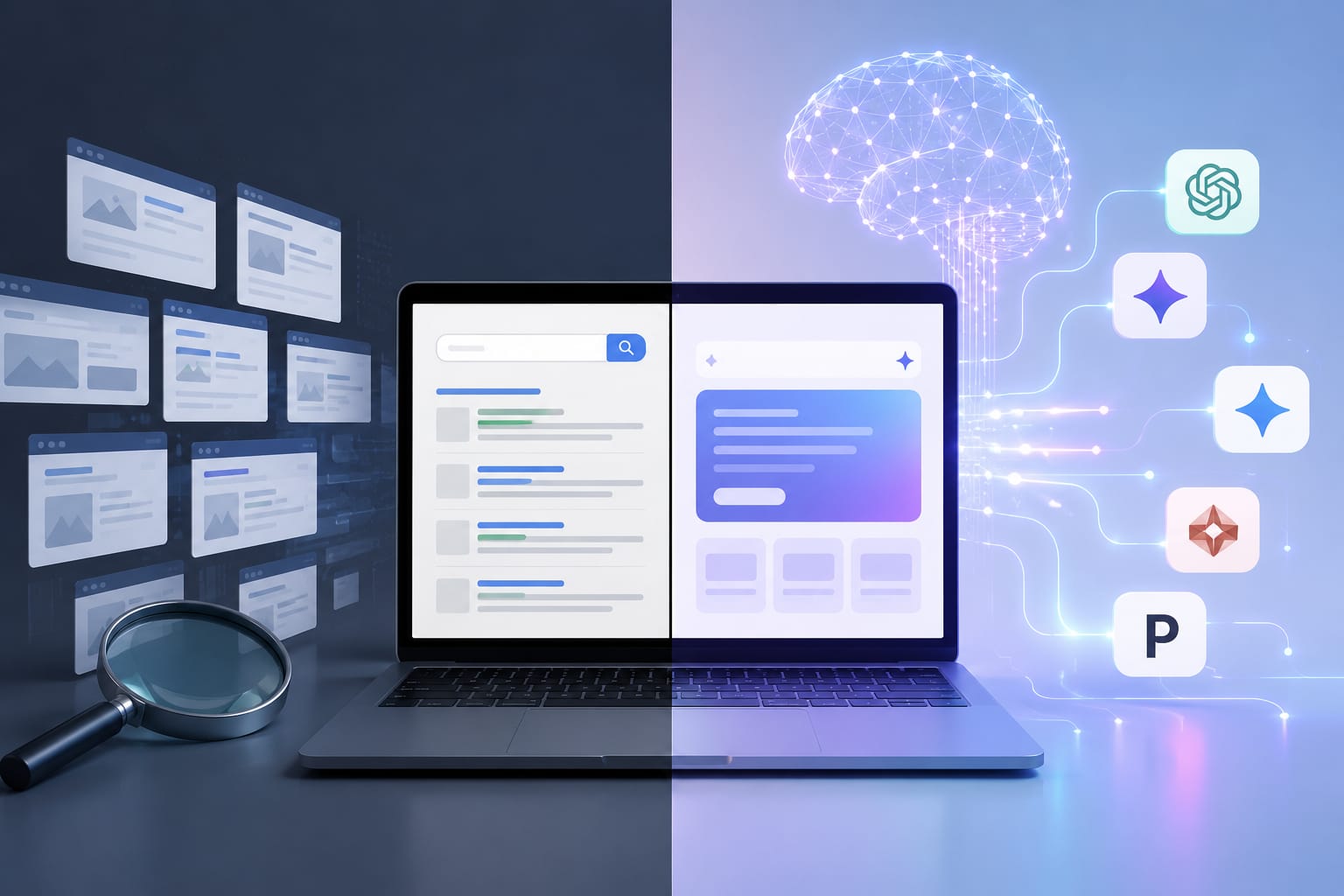
Most business owners think of a website as an online brochure—but website design AI visibility is now the real game, shaped heavily by Generative Engine Optimization (GEO) and reflecting how search engines and AI assistants find, understand, and recommend your business. A website showcases services, displays contact information, and hopefully brings in a few inquiries. That approach worked for years because traditional search engines focused heavily on keywords, backlinks, and content.
Today, the rules have changed.
Search is no longer limited to Google’s list of blue links. People are asking questions directly to AI assistants such as ChatGPT, Google AI Overviews, Gemini, Microsoft Copilot, Claude, and Perplexity. Instead of presenting ten search results, these platforms often provide one detailed answer with references to websites they trust—which is exactly why every website development company in Chandigarh should care about GEO.
That small change has a big impact on how websites should be built.
A website that looks attractive but has poor structure, confusing navigation, slow loading speed, or weak technical foundations may struggle to appear in AI-generated answers. On the other hand, a well-organized website with clear content, semantic HTML, fast performance, and strong technical SEO gives search engines and AI systems enough context to understand what the business does and when it should be recommended. This is exactly the kind of foundation a professional website development company in Chandigarh helps you build.
This is why website design AI visibility can no longer be treated as a separate task from SEO or digital marketing.
Design influences how visitors interact with a website. Development determines how efficiently the website performs. SEO helps search engines discover and index content. Generative Engine Optimization (GEO) ensures AI platforms can interpret, trust, and cite your content when answering users’ questions — something our AI development and automation services are specifically built to support.
For businesses across Chandigarh, Mohali, Panchkula, Zirakpur, and the wider Tricity region, this shift creates both a challenge and an opportunity. Companies investing in modern websites today are far more likely to benefit from AI-driven search over the coming years than businesses still relying on outdated designs built five or six years ago.
As a website designing company in Chandigarh, we’ve seen businesses redesign their websites not simply to improve aesthetics but to improve lead generation, search visibility, and customer trust. A modern website has become a business asset rather than just a marketing expense. We also help businesses integrate their websites with our AI development and automation services so they stay ahead of this shift instead of playing catch-up later.
In this article, we’ll look at how website design affects AI visibility, why Google increasingly rewards better user experiences, and what businesses should consider when planning a website that is ready for both traditional search and the next generation of AI-powered search engines.
What Is AI Visibility?
Simple Definition
Website design AI visibility refers to how easily artificial intelligence platforms can understand, trust, and recommend your website when answering users’ questions.
Unlike traditional SEO, where success often means ranking on the first page of Google, AI visibility focuses on becoming a trusted source of information that AI systems choose to reference.
Imagine someone asks:
“Who offers professional website development services in Chandigarh?”
Instead of showing ten blue links, an AI assistant may recommend only three or four businesses. The websites selected are usually those that clearly demonstrate expertise, provide structured information, answer questions comprehensively, and maintain strong technical standards.
That means your website isn’t just competing for rankings anymore—it’s competing to become a trusted source.
| Traditional Search | AI Search |
|---|---|
| Displays a list of web pages | Provides direct answers |
| Users compare multiple websites | AI summarizes information |
| Ranking position is the main goal | Being cited as a trusted source is the goal |
| Keywords play a major role | Context, entities, structure, and authority matter more |
| Users visit several pages | Many users may get answers without opening multiple websites |
Traditional Search vs AI Search
This doesn’t mean SEO is becoming less important. It means SEO is evolving.
A website still needs strong keyword optimization, but it also needs content that AI can understand and reuse confidently.
Why Website Design AI Visibility Plays a Bigger Role Than Ever
People often separate website design from SEO — but strong website design AI visibility comes from treating them as one strategy.
One team designs the website. Another team writes content. Someone else manages SEO.
In reality, these activities are deeply connected.
Every design decision affects how users behave. Those behaviours send signals to search engines.
If visitors leave your website within a few seconds because it is confusing or slow, search engines notice.
If visitors easily find answers, stay longer, explore additional pages, and complete enquiry forms, those positive engagement signals strengthen your website’s overall performance.
AI systems also benefit from websites that are easy to interpret.
For example, consider these two service pages.
Website A
- Huge banner image
- Very little text
- Generic headings
- Hidden content inside sliders
- Buttons without descriptions
- Poor navigation
To a visitor, it might look modern.
To AI, it provides very little usable information.
Website B
- Clear page title
- Descriptive headings
- Service explanation
- Frequently asked questions
- Comparison tables
- Internal links
- Structured schema
- Fast loading speed
The second website gives AI much more context.
It becomes easier for Google and AI assistants to understand:
- What services are offered
- Where the business operates
- Who the ideal customers are
- Why the company is trustworthy
Good design is no longer about decoration.
It is about communication.
How Google and AI Read a Website: The Technical Side of AI Visibility
A common misconception is that search engines “see” websites the same way people do. Understanding this is key to improving your website design AI visibility.
They don’t.
Visitors notice colours, typography, animations, and layouts.
Search engines read the underlying code.
AI systems analyze structure, relationships between topics, and semantic meaning.
For example, when someone lands on your homepage, they may immediately recognise that you offer website development services.
An AI model reaches the same conclusion differently.
It examines:
- HTML structure
- Heading hierarchy
- Internal links
- Schema markup
- Page titles
- Entity relationships
- Content organisation
- Image descriptions
- Navigation labels
- URL structure
Each of these elements contributes to understanding.
Imagine opening a book without chapter titles, page numbers, or a table of contents. Even if the content is excellent, finding information becomes difficult.
That’s exactly how AI experiences a poorly structured website.
The Importance of Semantic HTML
Many websites rely heavily on visual page builders that generate unnecessary code.
The page may look attractive but the underlying structure often becomes cluttered.
Semantic HTML solves this problem by using meaningful elements such as:
<header><nav><main><section><article><aside><footer>
These elements describe the purpose of each section instead of simply controlling appearance.
Search engines use these signals to understand page hierarchy.
Heading Structure Matters
One of the simplest mistakes found on business websites is inconsistent heading usage.
For example:
- H1
- H3
- H5
- H2
- H4
This creates confusion.
A logical structure looks like this:
- H1
- H2
- H3
- H2
- H3
It seems like a small technical detail, but it improves readability for users, accessibility tools, and search engines alike.
Website Structure Builds Trust and Website Design AI Visibility
Trust is one of the strongest ranking signals—both for humans and AI—and it’s a core part of website design AI visibility.
When visitors arrive on a website, they subconsciously ask several questions within seconds:
- Is this business genuine?
- Can I trust their expertise?
- Will they respond if I contact them?
- Have they completed similar projects before?
Your website should answer those questions without making visitors search for the information.
An AI-friendly website typically includes:
- Detailed service pages
- About Us page with company information
- Team or author profiles
- Client testimonials
- Case studies
- Frequently Asked Questions
- Contact details
- Business location
- Privacy Policy
- Terms & Conditions
These pages don’t just reassure potential customers—they also help search engines verify that the business is legitimate.
Businesses looking for a reliable Website Development Company in Chandigarh or SEO Company in Chandigarh often compare several agencies before making a decision. A website that clearly demonstrates experience, showcases real projects, and answers common questions is more likely to earn that trust than one that relies only on flashy visuals.